Tuesday, 2 October 2012

Marie Antoinette Propoganda


As Marie Antoinette's reputation diminished in France, an increasing amount of propoganda was used against her (some seen below). I want to take this idea and apply it to my own work about Marie Antoinette's downfall.


Marie Antoinette was renouned for her outragious hair and dresses and this has inspired me to over-exaggerate these features in order to satire my work.

However, I want to take this a stage further and use these features to portray Marie Antoinette's ignorance to conflict occuring in France. For example, for my final piece, If I were to draw a portrait of Marie Antoinette, I thought about using the folds in Antoinette's over blown dresses to hide little scenes, perhaps the storming of the Bastile or the imprisonment of her son Louis-Charles. These little scenes which will be in the shadows of the painting will emphasise Antoinette's inability to see what is happening around her, both physically and metaphorically.

In addition, I have been looking at an artist (currently unknown) who employs the use of material into her paintings. The material almost flows out of the painting and this is really interesting. 

 
I thought I could apply this kind of technique into my final piece and maybe tweak it slightly. Instead of having material flow out from the painting, i could use a material like mod roc to create a 3D 'dress' and underneath the ripples of the 'dress' could be the little scenes that are central to the idea of Marie Antoinette's ignorance. After speaking to my teacher, we thought aboout the idea of drawing my illustrations onto very light fabric, sewing them together and attaching them as the material of Marie Antoinette's dress. I could also screen print the same illustration onto the dress, which could be made of paper.

Monday, 1 October 2012

Louis-Charles XVII


The Dauphin, Louis-Charles, and heir to the throne was imprisoned in the Temple fortress during the revolution. He was seen as a potential threat to the republic and so revolutionaries put him under constant surveillance in a dark cell. They abused him and left him in isolation. His cell was not cleaned and there was no toilet facility for him to use. Therefore, his cell became infested with vermin and his physical and mental health diminished, until he died. It is quite hard to believe that the son of a King was actually treated in this manner. The fact that the political scene in France was constantly changing and there was fear that the monarchy could be restored at any moment frightened revolutionaries like Robespierres, to the extent that they locked up the prince in this inhumane manner. I think this is a really interesting aspect to the revolution and i'd like to comment on the story of this unfortunate prince somewhere in my work.

I have looked at Egon Schiele's work to inspire my drawings of Louis-Charles.


I really like the way Schiele uses simple lines to create rather striking body shapes. As Louis-Charles was left in isolation, his limbs became awkwardly elongated and his body unnaturally formed. Schiele's work portrays this whilst giving the sense of discomfort I want to achieve.

Jean-Honoré Fragonard

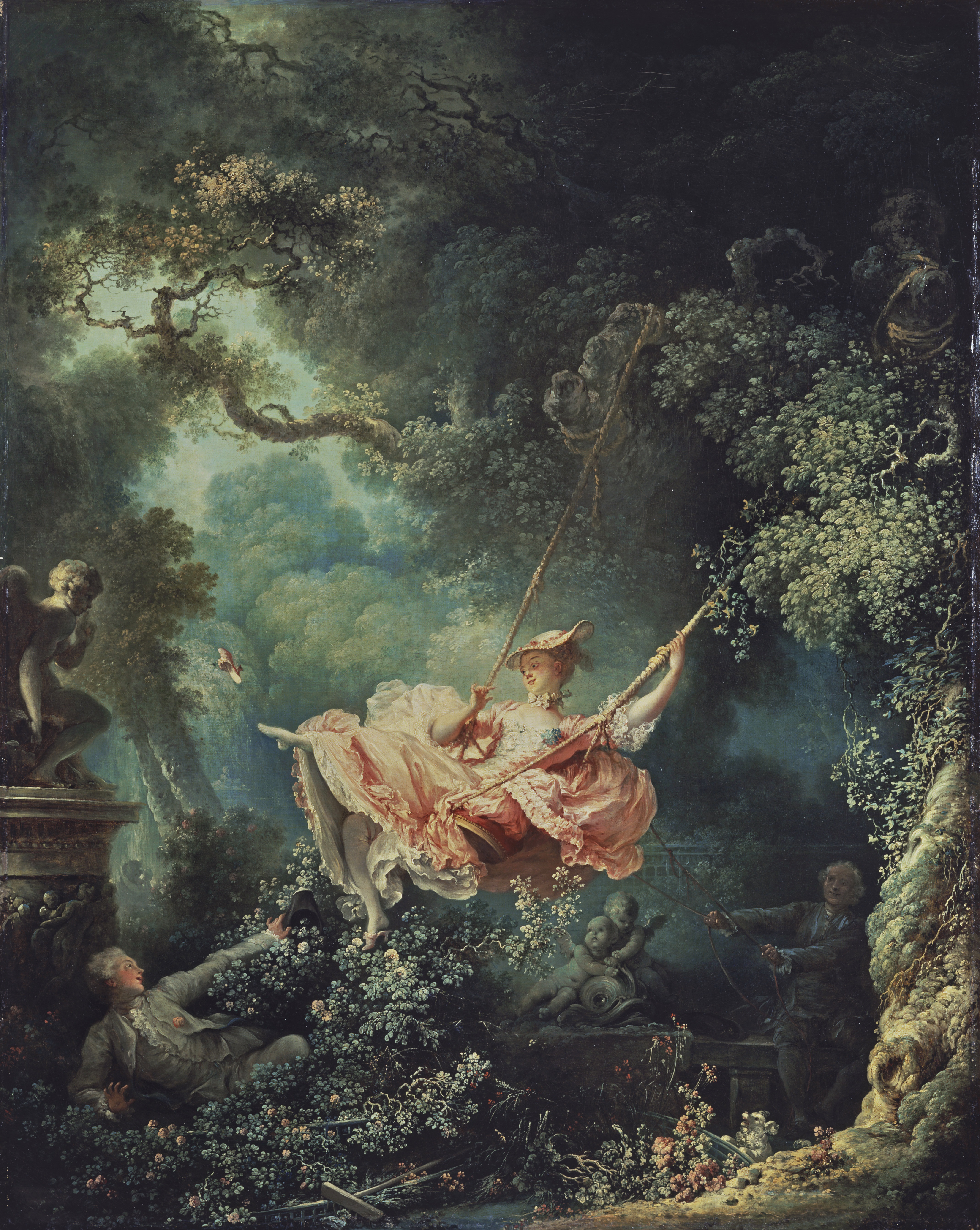
I have recently been inspired by the 18th century French artist Fragonard, in particular his work entitled The Swing:

File:Fragonard, The Swing.jpg

This painting depicts the frivolities of life led by the aristocracy. The lady enjoys a care free swing whilst the men in the shadows are waiting to assist her. This compares brilliantly to the life Marie Antoinette led in Versailles. She was extravagent and completely ignorant of the problems this was causing for the lower classes in France.

Also, the hat worn by the lady in this painting is a Bergère hat (a sheperdess hat). This is ironic because a sheperdess is usually associated with the idea of leading a humble life, being so close to nature. In the same way, Marie Antoinette sometimes dressed as a peasant woman whilst relaxing in the Le Petit Trianon and fed her animals, playing the commoner, but through ostentatious means, for example using an expensive china pouring jug. This mockery of the lower classes is really interesting and I would like to take this further. I might draw Marie Antoinette surounded by her corrupt luxuries and find a way to comment on it.

Le Petit Trianon:
     

Tuesday, 11 September 2012

Marie Antoinette

 
Marie Antoinette was the Queen of France and wife to Louis XVI. She was a frivolous and selfish individual that escaped her mundane life at the Versailles court by building expensive havens like 'The Petite Triannon', a mile from Versailles, where she would engage in gambling and drinking with her friends. It was even believed she had her secret love affair with Count Axel Fersen in the Triannon. With her extravagence came the regular people's poverty. Taxes were too high and there was a shortage of food and everyone looked to Marie Antoinette, or 'The Austrian Bitch' as to blame for their suffering. Like her husband, she was imprisoned and beheaded in 1793.

Louis XVI

 
Louis XVI was the fifth monarch of the Bourbon dynasty. He was a curious, enigmatic man and quite unlike his predecessors. From his childhood, he lacked in self-esteem and was percieved to be quite a mild person. Perhaps these personal traits were to blame for the indecision in his reign which led to famine in France and eventually a revolution. After years of imprisonment in a mediavel fortress called the Temple, Louis XVI was beheaded in 1793.
 
I would like to use key elements of Louis' reign and encorporate them into a drawing(or maybe a series of drawings), establishing a kind of simple narrative.

Versailles

This summer I spent a week in Paris and I thought it would be the perfect opputunity to visit Versailles, the old palace of the French monarchy. French history has always been one of my favourite parts of history so I thought this would be a good starting point for me. Here are some photos I took whilst walking round Versailles:


Monday, 25 June 2012

CROSS CURRICULAR

I am a big History obsessive and so this project brief was perfect for me to encorporate my interests from history into my final year of art a level.

Particular areas in history that I find interesting include:
  • The Norman Conquest
  • Henri IV of France and the French religious wars
  • Henry VIII's reign
  • "The Golden Age" of Queen Elizabeth
  • Prince Rupert, his life and contribution in the English Civil War
  • The French Revolution, particularly how this affected the Royal Family

MY PROJECT BRIEF
 
I intend to begin this unit by incorporating interests and influences from another subject through the title of “Cross Curricular.” Therefore, I have taken my love of History to experiment with the theme: “Stories in History.” I will begin by collecting and developing primary research which I intend to carry out over the summer holidays. I will visit History museums such as: Versailles and the Tower of London and photograph any important features. Using this primary research, I will then create a series of initial drawings and paintings from which I will try and create a narrative. For example, I will produce drawings of Louis-Charles XVI, the son of Louis XVI during the French Revolution, who was imprisoned, beaten and oppressed until his death at the age of eight. I might express this through my choice of materials, colour and line. Then, I will begin to develop my ideas and delve deeper into my topic, producing paintings that are captivating and have a story behind them. I would also like to write a short story for each painting, with my own illustrations and book cover design, briefly underling the key events so the viewer can fully comprehend the meaning behind the painting.